


How Much Does an EKG Cost Without Insurance in Suwanee GA?
At Lifeline Primary Care in Suwanee, GA, Dr. Aziz Pirani, MD offers affordable and transparent pricing for EKG testing without insurance. Our goal is to make heart health screenings accessible to everyone, providing reliable results with no hidden fees. Whether you’re looking for routine heart checks or have specific symptoms to investigate, we ensure you receive high-quality care at a price you can trust. For more information, contact us or request an appointment online. We are conveniently located at 4355 Johns Creek Pkwy, Suite 500, Suwanee, GA 30024.
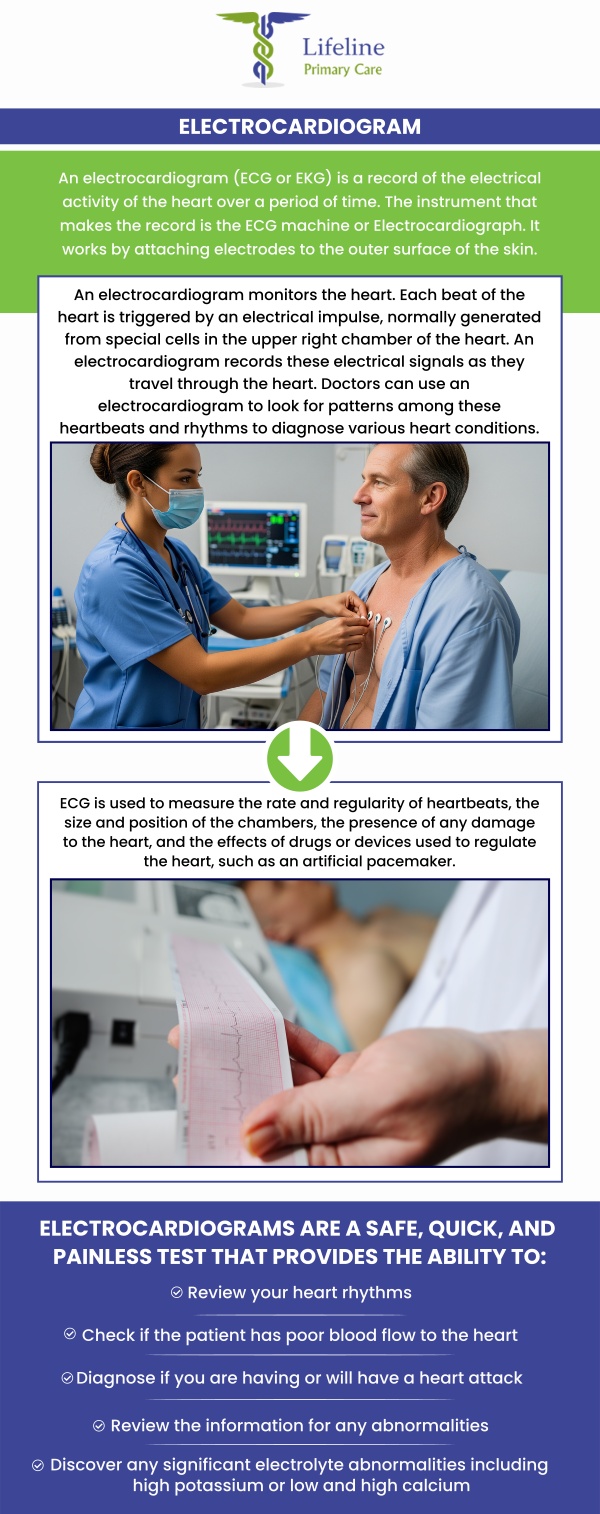
Table of Contents:
What is the typical cost of a basic EKG when paying out‑of‑pocket in Suwanee GA?
What factors can influence the price of an EKG test?
How accurate is an EKG in detecting heart arrhythmias?
Can an EKG identify past heart attacks?
How Can Dr. Safia Pirani and Dr. Aziz Pirani Help You Access Affordable EKG Testing in Suwanee, GA?
If you’re considering paying out‑of‑pocket for a basic EKG (electrocardiogram) in Suwanee, Georgia, understanding typical costs can help you plan ahead. A standard resting EKG — the simple, non‑invasive test that records your heart’s electrical activity — is one of the more affordable heart health screenings available.
Across the United States, when patients pay without insurance, the price of a basic EKG usually ranges from roughly $50 to $200 at outpatient clinics or urgent care centers. Specific online healthcare pricing tools show that even lower cash prices may be possible locally, depending on the facility, with some routine EKGs in Georgia averaging closer to $30 to $110. Larger hospitals or specialized imaging centers, however, can charge more if they bundle additional interpretation or impose facility fees.
At Lifeline Primary Care, you can expect competitive, transparent pricing for EKG services when you choose to pay out‑of‑pocket. Our approach focuses on delivering reliable results with clear information about any associated fees — including the cost of the test and physician interpretation — to help you budget with confidence.
Several variables affect how much you’ll pay for an EKG, whether you’re paying out‑of‑pocket or using insurance. Understanding these factors helps you avoid surprises and make informed decisions about your care.
1. Type of facility:
Costs can vary widely depending on where the test is performed. Hospitals and emergency departments typically charge more to reflect overhead and specialized staffing, while outpatient clinics or urgent care centers tend to offer more affordable rates.
2. Location:
Healthcare pricing often correlates with local cost of living and demand. Urban or high‑cost regions — including parts of Georgia — may have higher prices than rural areas.
3. Additional services:
Some providers charge separately for the EKG procedure and the physician’s interpretation of the results. If you require extra diagnostics or consultation alongside your EKG, the total bill can increase.
4. Insurance status and coverage:
If you have health insurance, it can dramatically reduce your out‑of‑pocket expense. Many plans cover EKG tests fully when they’re medically necessary, though co‑pays, deductibles, and coinsurance can still apply. Without insurance, you’re responsible for the full cash price.
5. Test complexity:
A basic resting EKG (a quick recording of heartbeat at rest) is typically the least expensive. More involved procedures — such as stress tests or ambulatory monitoring like Holter monitors — can cost more because they require additional time and equipment.
By discussing your needs and expected costs upfront with the team at Lifeline Primary Care, led by Dr. Aziz Pirani, MD, you’ll get a clear picture of pricing before your appointment.
An EKG is a vital, widely used tool for detecting heart rhythm abnormalities (arrhythmias). It records the electrical impulses that control your heartbeat. When interpreted by a trained clinician, an EKG can reliably detect many arrhythmias, such as atrial fibrillation, bradycardia (slow heart rate), or tachycardia (fast heart rate), particularly when those rhythm irregularities are present during the brief recording.
However, because a standard EKG captures only a short snapshot of heart activity (usually a few seconds), it may not detect arrhythmias that occur intermittently. For example, if you experience palpitations only once in a while, your heart may appear normal during the test. In such cases, extended monitoring — such as with a Holter monitor worn for 24–48 hours — can dramatically increase detection sensitivity.
Despite this limitation, an EKG remains one of the most accurate initial tests for common arrhythmias and is often the first step in diagnosing heart rhythm disorders. Results are interpreted by trained healthcare professionals who look for patterns that indicate electrical abnormalities.
Yes — a standard electrocardiogram can provide clues that suggest you’ve had a past heart attack (also called a myocardial infarction). After a heart attack, the heart muscle may develop characteristic changes in the electrical recording that experienced clinicians can recognize.
Specifically, areas of scar tissue or altered conduction due to prior heart muscle damage may show changes in certain wave patterns on the EKG. However, an EKG isn’t perfect; scars from older or less severe events might not always be clearly visible, and some electrical changes can be subtle. In addition, other conditions can sometimes mimic the signs of past injury.
For a comprehensive evaluation of past heart attack damage, doctors often correlate EKG findings with other diagnostic tools, such as cardiac imaging (echocardiograms or stress tests) and laboratory markers.
At Lifeline Primary Care in Suwanee, Dr. Safia Pirani, MD, and Dr. Aziz Pirani, MD, are dedicated to ensuring that essential heart health monitoring remains accessible to everyone, regardless of insurance status. An Electrocardiogram (EKG) is a vital diagnostic tool used to detect irregular heart rhythms and potential cardiac issues. Recognizing that high medical costs can often prevent patients from seeking necessary care, the doctors at Lifeline Primary Care offer transparent, competitive self-pay pricing for EKGs and other diagnostic services.
With a compassionate, multilingual staff and a focus on preventative wellness, Dr. Safia and Dr. Aziz Pirani provide a supportive environment where patients can receive immediate answers about their cardiovascular health. Whether you are experiencing chest discomfort or require a routine screening, the Suwanee team ensures that cost is not a barrier to high-quality medical attention.
At Lifeline Primary Care, we provide personalized EKG testing with transparent pricing and professional interpretation to support your heart health journey. For more information, contact us or request an appointment online. We are conveniently located at 4355 Johns Creek Pkwy, Suite 500, Suwanee, GA 30024. We serve patients from Suwanee GA, Johns Creek GA, Duluth GA, Alpharetta GA, Sugar Hill GA, Norcross GA, Buford GA, and surrounding cities.
Check Out Our 5 Star Reviews


Additional Services You May Need
• Sports Physical Exam
• School Physical Exam
• X-Ray
• Foreign Body Removal
• Minor Surgeries
• Confidential STD Screening
• Allergy Testing
• Immigration Physical Exams
• IUD Insertion
• DOT Physical Exam
• Knee Gel Injections
• Chronic Care Management
• Women’s Health
• Vitamin B12 Injections
• Myers Cocktail IV Therapy
• Weight Management
• Suturing Clinic
• Incision and Drainage
• Dermatological Procedures
• Skin Tag Removal
• Toenail Removal
• Biopsies
• Lab Services
• Lead Screening
• Hormone Replacement (Pellet) Therapy
• TB Screening
• Hearing/Vision Test
• EKG Services
• Spirometry Testing
• Echocardiograms
• Ultrasounds
• ABI (Circulation Test)
• Urine Drug Testing
• Nerve Conduction Studies
• Annual Physicals
• Immunotherapy
• Neuro Scans
• Employment Physicals
• Medicare Wellness Exams
• VAT/ENG Studies
• Autonomic Nervous System Scans
• Nuclear Scans
• Acute Care
• Smoking Cessation
• Immunizations
• Joint Injections
• Vaccinations
• Covid-19 Vaccines
• Nexplanon
• Primary Care
• Flu Shot

Additional Services
You May Need
• Sports Physical Exam
• School Physical Exam
• Primary Care
• X-Ray
• Foreign Body Removal
• Minor Surgeries
• Confidential STD Screening
• Allergy Testing
• Immigration Physical Exams
• IUD Insertion
• DOT Physical Exam
• Knee Gel Injections
• Chronic Care Management
• Women’s Health
• Vitamin B12 Injections
• Myers Cocktail IV Therapy
• Weight Management
• Suturing Clinic
• Incision and Drainage
• Dermatological Procedures
• Skin Tag Removal
• Toenail Removal
• Biopsies
• Lab Services
• Lead Screening
• TB Screening
• Hearing/Vision Test
• EKG Services
• Spirometry Testing
• Echocardiograms
• Ultrasounds
• ABI (Circulation Test)
• Urine Drug Testing
• Nerve Conduction Studies
• Annual Physicals
• Immunotherapy
• Neuro Scans
• Employment Physicals
• Medicare Wellness Exams
• VAT/ENG Studies
• Autonomic Nervous System Scans
• Nuclear Scans
• Acute Care
• Smoking Cessation
• Immunizations
• Joint Injections
• Vaccinations
• Covid-19 Vaccines
• Nexplanon
• Hormone Replacement (Pellet) Therapy
• Flu Shot




 Send Text
 How May I Help You?