


How Is Vitamin B12 Injection Dosage Determined for Adults in Daily mL Amounts in Duluth GA?
Determining the appropriate daily mL dosage for adult Vitamin B12 injections requires a comprehensive evaluation of a patient’s specific lab results, deficiency severity, and individual health history. At Lifeline Primary Care, Dr. Aziz Pirani, MD, and Dr. Safia Pirani, MD, meticulously assess these critical factors to calculate the precise formulation volume needed to safely restore vital energy levels and neurological function. Their highly personalized and evidence-based approach ensures that every adult receives the exact, targeted treatment necessary to combat fatigue and achieve optimal long-term wellness. For more information, contact us or request your appointment online today. We are conveniently located at 4855 River Green Parkway, Suite 700A, Duluth, GA 30096.
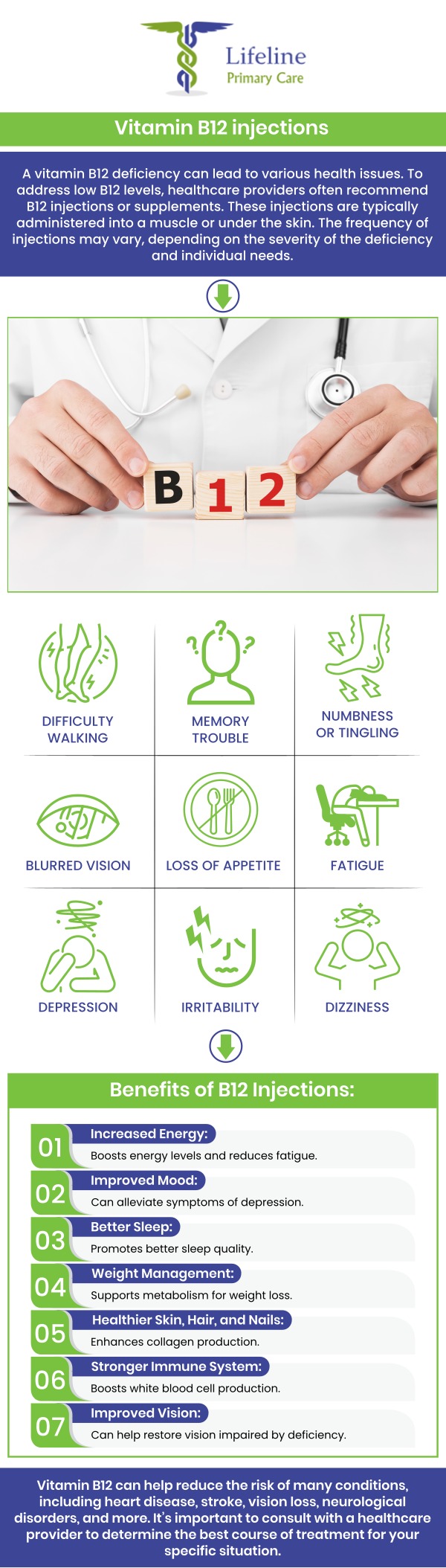
Table of Contents:
What is the typical vitamin B12 injection dosage range for adults?
How do healthcare providers determine the appropriate vitamin B12 injection dosage in mL?
Does vitamin B12 injection dosage vary based on individual health needs?
How often should adults receive vitamin B12 injections based on their dosage requirements?
How Do Dr. Aziz Pirani and Dr. Safia Pirani Determine the Right Vitamin B12 Dosage?
Typically, vitamin B12 injections range from 100 to 1000 micrograms (mcg) per dose. For patients with severe deficiency or conditions such as pernicious anemia, our team may recommend an initial loading phase, which often involves administering 1000 mcg of B12 intramuscularly or subcutaneously daily or every other day for one to two weeks. After this initial phase, we will usually transition you to a weekly injection schedule for several weeks, followed by monthly injections for ongoing maintenance.
Your exact dosage and injection frequency will be tailored to your specific needs and closely monitored by our medical professionals at Lifeline Primary Care. If you suspect you have a vitamin B12 deficiency or have been diagnosed with one, schedule an appointment with us to discuss your treatment options and receive personalized care.
At Lifeline Primary Care, our healthcare providers use a personalized approach to determine the most appropriate vitamin B12 injection dosage for each patient. This process starts with a comprehensive medical evaluation, where we review your symptoms, medical history, and any specific risk factors you may have for vitamin B12 deficiency. We may also recommend blood tests to accurately measure your serum vitamin B12 levels and, if needed, related markers such as methylmalonic acid or homocysteine. These steps help us confirm the diagnosis and understand the severity of your deficiency.
Once a vitamin B12 deficiency is identified, our team will select the best form of injectable vitamin B12 for your needs, most commonly cyanocobalamin or hydroxocobalamin. Each form comes in standard concentrations—often 1000 micrograms per milliliter (1000 mcg/mL)—which guides us in determining the exact volume (in milliliters) to administer for your treatment.
The initial phase of treatment usually involves higher and more frequent doses to quickly restore healthy vitamin B12 levels. For example, a typical starting regimen may involve 1000 mcg (1 mL of a 1000 mcg/mL solution) given intramuscularly or subcutaneously on a daily or several-times-weekly basis for one to two weeks. After this correction phase, we may transition you to a maintenance dose, such as 1000 mcg every month, or adjust the regimen according to your unique health needs and response to treatment.
Throughout your care at Lifeline Primary Care, our providers will closely monitor your progress, both by observing your clinical response and by repeating laboratory tests as needed.
At Lifeline Primary Care, determining the right vitamin B12 injection dosage involves a careful, individualized assessment—combining clinical expertise, lab data, and a focus on your overall health and safety.
Several factors influence the appropriate dose of vitamin B12, including the severity and underlying cause of your deficiency, your age, overall health status, and your body’s ability to absorb vitamin B12 from food or oral supplements.
For example, patients with conditions like pernicious anemia or significant absorption issues—such as those caused by gastrointestinal disorders (like Crohn’s disease or celiac disease), a history of gastric surgery, or certain long-term medications—often require higher or more frequent doses, especially when starting treatment. In these cases, our providers may recommend injections every day or every week until levels stabilize. Once your vitamin B12 levels are within a healthy range, we typically reduce the frequency to maintenance injections, which may be given monthly.
If you have a mild deficiency or are using B12 injections for preventive purposes, you may require lower doses or less frequent administration. Age is also a factor, as older adults may have decreased absorption and need tailored dosing.
At Lifeline Primary Care, your optimal dosage and schedule are always determined by a healthcare professional, based on your lab results, symptoms, medical history, and the root cause of your deficiency. We provide regular monitoring to ensure your vitamin B12 levels remain in a healthy range and adjust your treatment as needed.
The frequency of vitamin B12 injections varies from patient to patient and depends on several key factors—including the underlying reason for supplementation, your body’s ability to absorb vitamin B12, and your individual dosage needs.
For patients with severe vitamin B12 deficiency or pernicious anemia, our initial treatment protocol may involve more frequent injections, such as daily or every other day for one to two weeks. This intensive phase is designed to quickly restore healthy B12 levels and address symptoms as soon as possible.
Most adults will require monthly (every four weeks) injections, but in some cases, injections every two to three months may be appropriate, depending on your lab results and how you respond to treatment. For patients with absorption issues—such as those who have had gastric surgery or have chronic gastrointestinal conditions—lifelong monthly injections may be necessary.
If your vitamin B12 injections are prescribed for a less severe deficiency or as general supplementation, your provider will determine an appropriate schedule that may be less frequent.
We emphasize a personalized approach for all our patients. Your injection schedule will be tailored to your specific medical condition, laboratory findings, and how you respond to treatment. Regular blood tests at Lifeline Primary Care help us monitor your vitamin B12 levels and make adjustments as needed.
Most importantly, always follow your provider’s recommendations regarding the frequency and dosage of vitamin B12 injections. If you have any questions about your treatment plan, our team is here to help.
There is no single daily millilitre amount that is appropriate for every adult receiving vitamin B12 injections. At Lifeline Primary Care, Dr. Aziz Pirani, MD, and Dr. Safia Pirani, MD, consider the patient’s symptoms, medical history, blood test results, severity and cause of deficiency, absorption concerns, current medications, and response to previous supplementation. Vitamin B12 dosage is prescribed in micrograms or milligrams, while the amount measured in mL depends on the concentration of the specific injectable product. For example, a solution containing 1,000 mcg per mL will require a different injection volume than a more concentrated formulation.
Patients in Duluth, GA, may receive a more frequent initial injection schedule when a confirmed deficiency requires correction, followed by less frequent maintenance doses as levels and symptoms improve. Dr. Aziz Pirani and Dr. Safia Pirani may use follow-up bloodwork and clinical response to determine whether the dosage or frequency should change. Vitamin B12 injections should remain physician-directed because the appropriate amount and schedule depend on the underlying diagnosis rather than fatigue or wellness goals alone. For more information, contact us or request your appointment online today. We are conveniently located at 4855 River Green Parkway, Suite 700A, Duluth, GA 30096. We serve patients from Duluth GA, Johns Creek GA, Norcross GA, Peachtree Corners GA, Alpharetta GA, Sugar Hill GA, and surrounding cities.
Check Out Our 5 Star Reviews


Additional Services You May Need
• Sports Physical Exam
• School Physical Exam
• X-Ray
• Foreign Body Removal
• Minor Surgeries
• Confidential STD Screening
• Allergy Testing
• Immigration Physical Exams
• IUD Insertion
• DOT Physical Exam
• Knee Gel Injections
• Chronic Care Management
• Women’s Health
• Vitamin B12 Injections
• Myers Cocktail IV Therapy
• Weight Management
• Suturing Clinic
• Incision and Drainage
• Dermatological Procedures
• Skin Tag Removal
• Toenail Removal
• Biopsies
• Lab Services
• Lead Screening
• Hormone Replacement (Pellet) Therapy
• TB Screening
• Hearing/Vision Test
• EKG Services
• Spirometry Testing
• Echocardiograms
• Ultrasounds
• ABI (Circulation Test)
• Urine Drug Testing
• Nerve Conduction Studies
• Annual Physicals
• Immunotherapy
• Neuro Scans
• Employment Physicals
• Medicare Wellness Exams
• VAT/ENG Studies
• Autonomic Nervous System Scans
• Nuclear Scans
• Acute Care
• Smoking Cessation
• Immunizations
• Joint Injections
• Vaccinations
• Covid-19 Vaccines
• Nexplanon
• Primary Care
• Flu Shot

Additional Services
You May Need
• Sports Physical Exam
• School Physical Exam
• Primary Care
• X-Ray
• Foreign Body Removal
• Minor Surgeries
• Confidential STD Screening
• Allergy Testing
• Immigration Physical Exams
• IUD Insertion
• DOT Physical Exam
• Knee Gel Injections
• Chronic Care Management
• Women’s Health
• Vitamin B12 Injections
• Myers Cocktail IV Therapy
• Weight Management
• Suturing Clinic
• Incision and Drainage
• Dermatological Procedures
• Skin Tag Removal
• Toenail Removal
• Biopsies
• Lab Services
• Lead Screening
• TB Screening
• Hearing/Vision Test
• EKG Services
• Spirometry Testing
• Echocardiograms
• Ultrasounds
• ABI (Circulation Test)
• Urine Drug Testing
• Nerve Conduction Studies
• Annual Physicals
• Immunotherapy
• Neuro Scans
• Employment Physicals
• Medicare Wellness Exams
• VAT/ENG Studies
• Autonomic Nervous System Scans
• Nuclear Scans
• Acute Care
• Smoking Cessation
• Immunizations
• Joint Injections
• Vaccinations
• Covid-19 Vaccines
• Nexplanon
• Hormone Replacement (Pellet) Therapy
• Flu Shot




 Send Text
 How May I Help You?